Fomo Glossary: Trading Terms Explained Simply
57 trading terms on Fomo in plain English, from cash balance and slippage to liquidation price and funding, with where each one shows in the app.

Fomo is easy to use, but its screens are full of trading words that nobody explains: bonding, slippage, dust, mark price, funding. This glossary defines 57 of them in plain English. Each entry says what the word means in general and where it shows up in the Fomo app, so you can match it to the screen in front of you.
Terms are grouped by where you meet them: your account and money, tokens, trading, perps, and the social side of the app.
Your account and your money
Cash balance
The money you can spend on your next trade. On Fomo it is USDC held in your Solana wallet, and the same balance pays for tokens on all seven chains. Where you see it: the top of the Home screen and the Portfolio tab.
USDC
A stablecoin designed to stay worth one US dollar. It is what your cash balance is made of, and it's the coin you send in when you deposit crypto.
USDG
Another dollar stablecoin, used for deposits on Robinhood Chain instead of USDC. It turns into Solana USDC cash when it arrives.
Perps cash balance
A second, separate pool of USDC that backs your perps positions. You move money into it from your cash balance before your first perps trade, and Fomo charges nothing for that transfer.
Non-custodial wallet
A wallet where you hold the keys and the company doesn't. Fomo makes two for you at sign-up, a Solana wallet and an EVM wallet. Nobody at Fomo can move your funds, and nobody can undo a mistake for you either.
EVM wallet
EVM stands for Ethereum Virtual Machine. One Fomo wallet with one address covers every EVM chain in the app: Base, BNB Chain, Monad, Ethereum, Robinhood Chain and Arc.
Private key
The secret that controls a wallet. Fomo has no seed phrase; you can export the key itself at fomo.family/export-key. Anyone who has it can empty the wallet, so no one, including support, should ever see it.
Deposit address
The wallet address you send crypto to. Solana has its own, and the EVM chains share one. Where you see it: Deposit, then Crypto, then the network.
Network minimum
The smallest crypto deposit that credits to cash. It is 0.50 on Base, BNB Chain, Monad and Robinhood Chain, none on Solana, and highest on Ethereum. Smaller amounts wait at your address until a top-up pushes them over.
MFA (multi-factor authentication)
A second check, from an authenticator app and optionally a passkey, on top of your Apple or Google login. Once it's on, every withdrawal, send and key export asks for it. Where you see it: Settings, then Security.
Screen Lock and PIN lock
Screen Lock locks the phone app with Face ID, Touch ID or your fingerprint. The web app uses a PIN lock instead, saved to your account so every browser asks for it.
Blur balances
Hides every dollar figure as stars, for screenshots or a shared screen. In the app you tap the balance; on the web it's in the menu under your profile picture.
Tokens and the market
Memecoin
A token built around a joke, a meme or a community rather than a product. Most tokens on Fomo are memecoins. They can rise a hundred times or go to zero in a day.
Contract address
The unique on-chain address of a token. Two tokens can share a name, but never an address, so searching by address is the safe way to find the right one. Where you see it: on the token page, and in the Paste button of Search.
Market cap
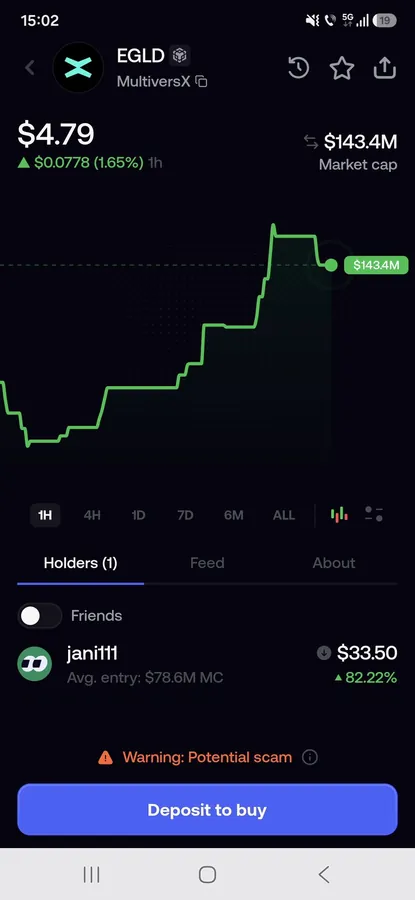
The token's price times the number of tokens that exist. A $40,000 market cap coin is tiny and moves on small trades; a $400 million one moves far less on the same money. Where you see it: the token page and the Discover table.
Liquidity
How much money sits in the pool that the token trades against. Thin liquidity means a modest buy or sell moves the price a lot, and you may get a worse fill than the quote.
Holders
How many wallets hold a token, and how much the biggest ones own. Fomo shows how many Fomo users hold it as well as the total. If a handful of wallets own most of the supply, a single sale can crash the price.
Bonding curve and Bonding
Many new tokens launch on a launchpad where the price follows a formula, the bonding curve, until enough money has gone in. The Bonding filter on the Tokens list shows coins still on that curve. They are the newest and the wildest.
Graduated
A token that finished its bonding curve and moved to a normal trading pool. The Graduated filter shows tokens created in the last 24 hours that have already graduated, and every fresh graduate starts as unverified.
Verified token
A token the Fomo team has reviewed, marked with a blue check on its logo. To be considered it needs roughly $1 million in daily volume, a $5 million market cap and 1,000 holders. Verified doesn't mean safe from a price drop.
Warning labels
Tags on tokens that look risky, for example a contract that blocks sells or high taxes. A severe warning asks you to confirm before you buy, and some turn the Buy or Sell button off.
Team tag
A Team badge on holders who belong to the token's own team, shown in the Holders tab. It tells you how much the people behind a coin still hold.
Token tax
A fee written into some tokens' contracts and charged on every buy or sell. It goes to the token's creators, not to Fomo, and it shows as a Token tax row in the trade details.
Stock token
A token on Robinhood Chain that represents a company's shares. Closed to people in the US, Canada, the UK and Switzerland.
Watchlist
Your starred tokens, plus anything you hold. Tap the star on a token page to add one.
Dust
A holding too small to sell, often what's left after a sale or after a coin collapses. Holdings under $2 are hidden by default; tap Show hidden in the app, or Show dust on the web, to see them.
Trading words
Spot trade
Buying a token outright and owning it. Every normal buy on Fomo is a spot trade. You make money only if the price goes up.
Quote
The estimate you see before you confirm: how many tokens you get, at what price, after fees. It's a forecast, not a promise.
Slippage
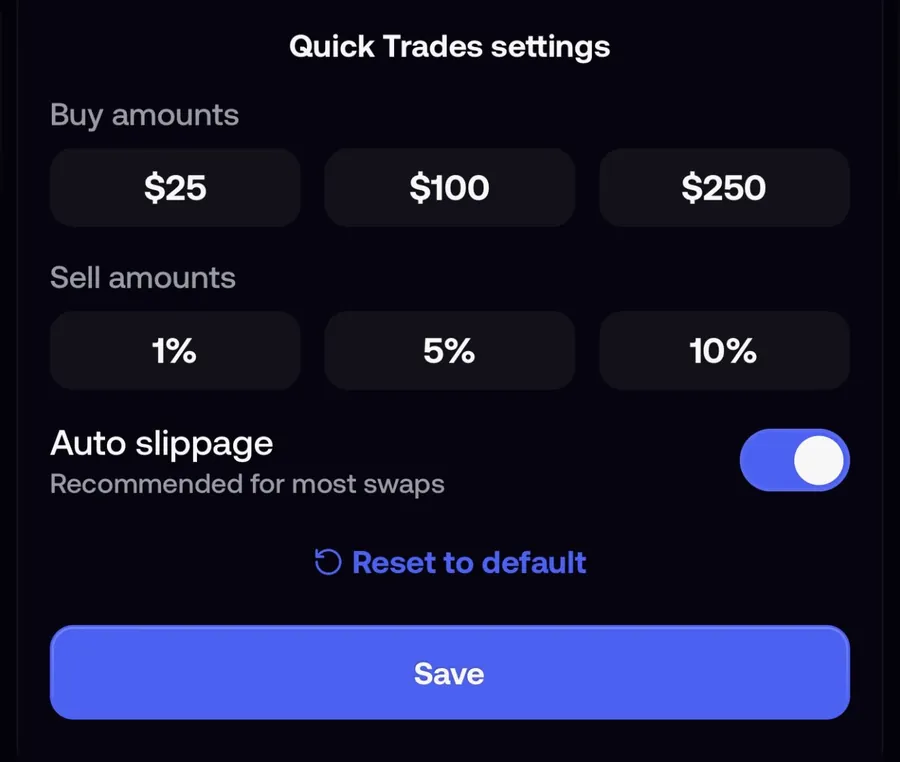
The gap between the quote and the price your trade actually fills at. Fomo's setting is on Auto unless you change it. A custom value is the most movement you will accept, and the trade fails instead of filling past it. Where you see it: the Slippage row in the trade details.
Price impact
How much your own trade moves the price, which grows as liquidity shrinks. The app warns you when it is large.
Trading fee
What Fomo charges per trade. On Solana it depends on size and route, from 0.10 USDC on tiny trades to 0.50% above 190 USDC; elsewhere it is 0.50% plus the network fee. A referral code cuts the 0.50% rate to 0.45%.
Network fee (gas)
The fee the blockchain itself charges to process a trade. Fomo pays it on Solana. On the other chains you pay it, and Ethereum costs the most.
Token rent
A one-time Solana cost for opening a token account the first time you buy a token. Fomo covers it.
Quick Trades
Buy and sell chips behind the lightning bolt on a token page in the phone app. A chip sends the order at once, with no slide to confirm, so the 100% sell chip sells your whole position in one tap.
Quick buy
One-click buying from the Discover table on the web, for amounts from $2 to $5,000. It skips the price impact review.
PnL
Profit and loss. Open PnL is your return on a position you still hold. Realized PnL is what you actually made or lost when you sold, based on the price you got rather than the quote. It refreshes about once a minute.
Transaction hash
The ID of a blockchain transaction. You need it to track a deposit or withdrawal, and support asks for it. Where you see it: open the transfer in History.
Bridge
A way to move value from one blockchain to another. Fomo does this for you when you buy a token on a chain other than Solana, so you never bridge by hand.
Perps words
Perps (perpetual futures)
Contracts that track an asset's price without you owning the asset, with no expiry date. You can bet on the price going up or down. Not available to U.S. persons.
Long and short
Going long means you profit if the price rises. Going short means you profit if it falls.
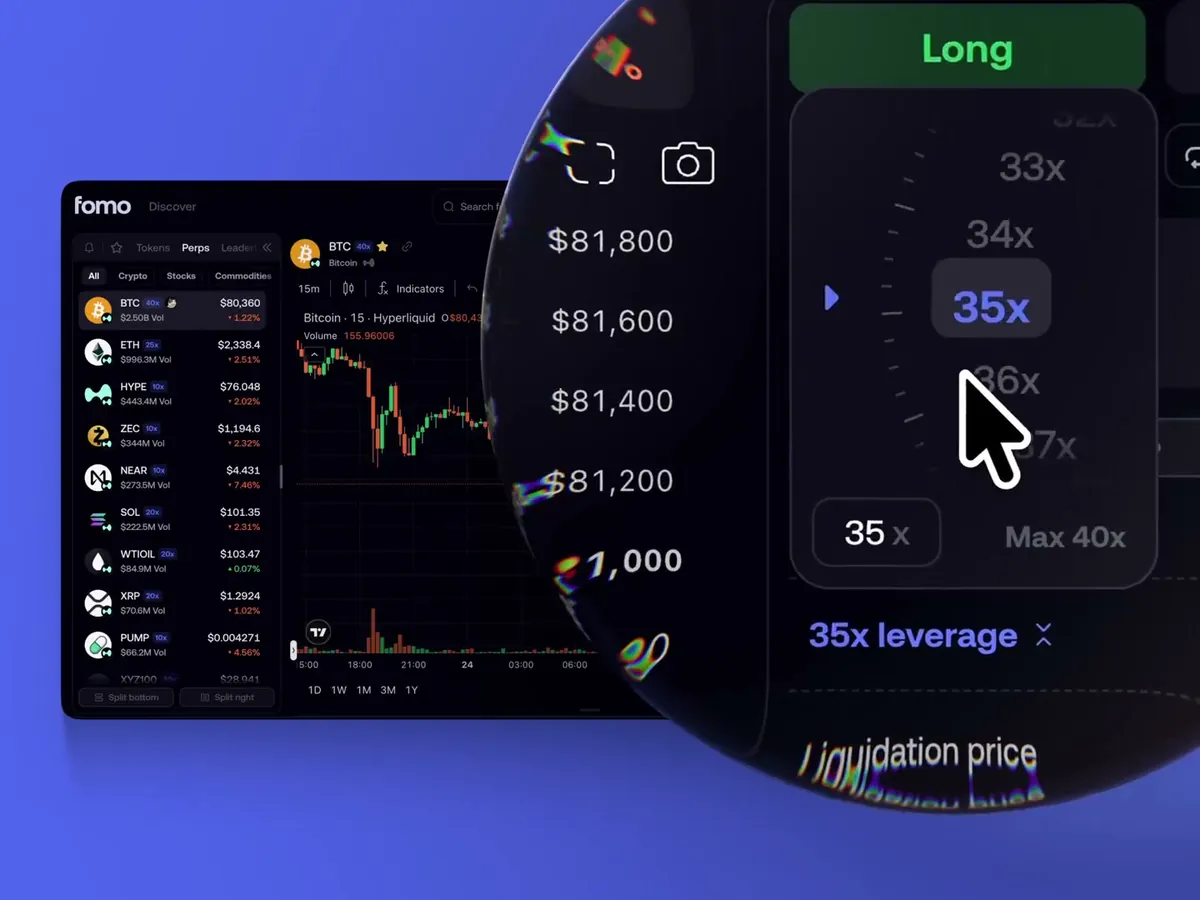
Leverage
Controlling a bigger position than your money alone would allow. At 10x, 100 USDC controls a 1,000 USDC position, and a move of less than 10% against you can liquidate it.
Initial margin
The USDC you lock up to open a perps position. A 1,000 USDC position at 10x needs 100 USDC; at 5x it needs 200.
Maintenance margin
The minimum a position must keep to stay open. On a 40x market like BTC it is 1.25% of the position size. Drop below it and the position is liquidated.
Liquidation price
The price at which your position closes automatically and your margin is gone. It's an estimate shown on the order screen, and it triggers off the mark price, not the last price on the chart.
Mark price
The protocol's reference price, built from prices on major exchanges plus its own trading. It stops one brief spike from liquidating you, and it's why a position can close while the chart shows a different number.
Isolated and cross margin
Isolated, the default, risks only the margin of that one position. Cross shares your whole perps cash balance between positions, so a loss on one can push another toward liquidation. Fomo marks cross as Advanced.
Funding rate
A small payment between longs and shorts, settled every hour while your position is open. You may pay it or receive it. Where you see it: Funding rate (1h) in a market's About section.
Limit order and limit close
An order that fills only at your price or better. On Fomo perps you can open with a limit order, or close a position at a target price with Close position, then Limit.
TWAP
Time-weighted average price: one big order split into small market orders spread over anywhere from 5 minutes to 7 days. Fomo charges no fee of its own on a TWAP.
Stop loss and take profit
Orders that close a perps position automatically at a loss limit or a profit target. They exist for perps on Fomo; spot trades have no stop loss.
The social side
Feed
The live stream of trades and posts. Global shows everyone, Following shows only traders you follow. Trades under $1,000 are hidden by default, so a quiet feed often means the filter needs changing.
Thesis
A written take of up to 3,000 characters on why you hold a token. You can post one only on a token you hold, and it shows on the token page, your profile and the feed.
Leaderboard
Traders ranked by real profit and loss over 24 hours, 7 days, 30 days or all time. The top 100 all-time traders get a badge.
Clan
A group of traders ranked together on combined PnL. You find clans in Search and on the Clans tab of the leaderboard, which is in the phone app only.
Share card and replay card
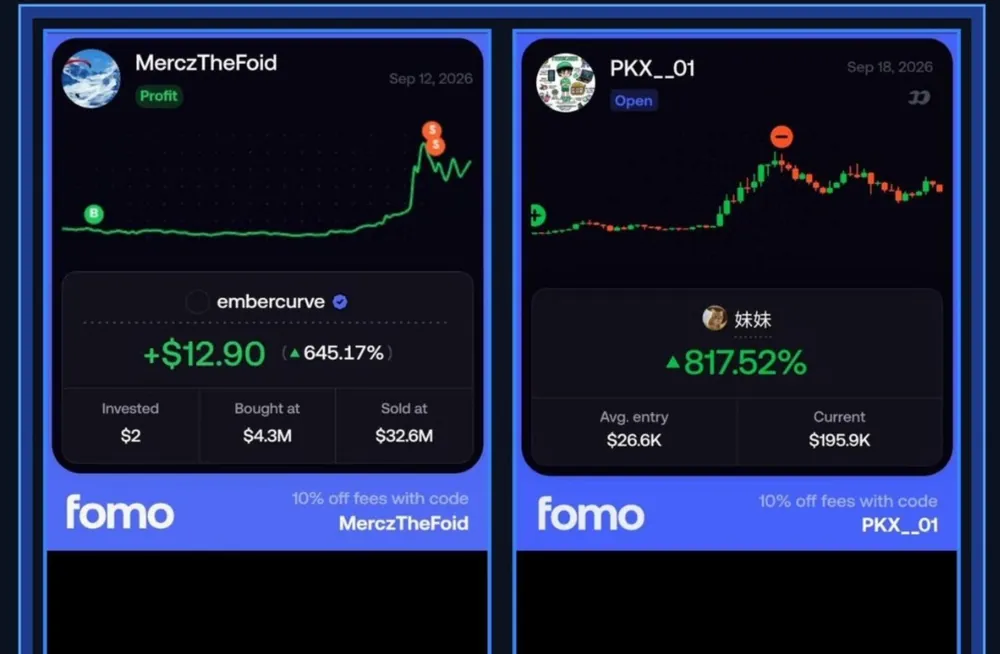
Images of a trade, a thesis or your holdings that you can post on X. A replay card plays a trade from entry to exit.
Creator rewards
A share of Fomo's fee paid to you when your post, profile or position leads someone else to trade. Fomo announced it as Trader Rewards in August 2026. Where you see it: the Rewards screen.
Referral code
A code entered at sign-up that gives you 10% off the standard fee, so 0.50% becomes 0.45%. It has to be added before your first trade. Ours is referral code GEMQUEENX, and the referral code page explains where to type it.
Where to go next
Words make more sense on the screen. Take the tab-by-tab tour of the Fomo app, then read how the cash balance works and how to set slippage. If perps tempt you, start with what perps are on Fomo and keep the size small.
 Written by Mohammad ShahpariCrypto and SEO specialist
Did this answer your question?
Thanks for the feedback.